
Your boiler is wasting up to 10% of every gas bill. Here’s the easy fix
by Aaron Hannah
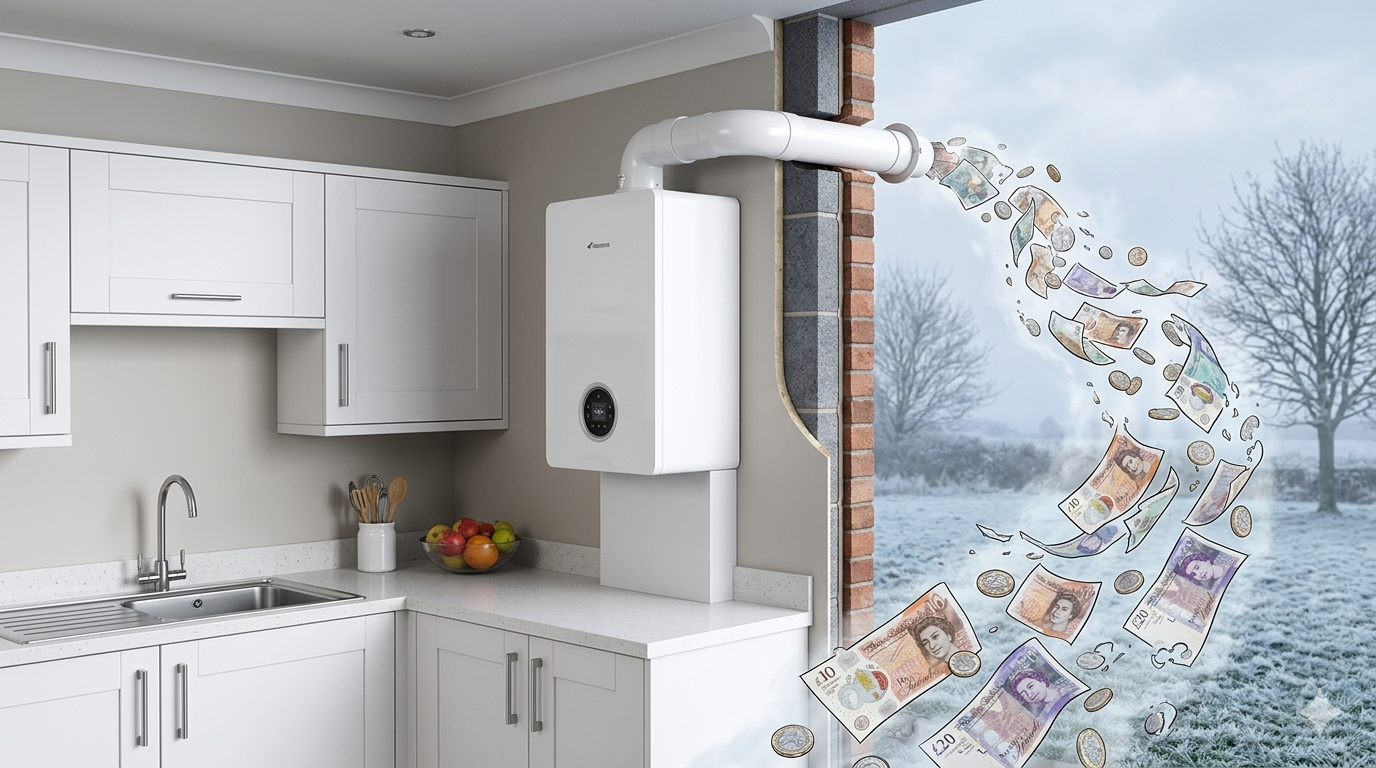
If your home has a modern gas boiler, there’s a good chance it’s working harder than it needs to — and costing you more than it should. Synergie Environ energy engineer Aaron Hannah explains why lowering your heating system’s operating temperature is the most overlooked efficiency upgrade available to UK homeowners right now, and why it also happens to future-proof your home for whatever comes next.
Your condensing boiler may not actually be condensing
Almost every gas boiler installed in the UK since 2005 is a condensing boiler — a design that’s significantly more efficient than older models. Yet the efficiency gain many of these boilers were designed to deliver is going unrealised in a large number of homes, through no fault of the boiler itself.
Here’s how a condensing boiler works. When gas burns, it produces water vapour as a byproduct — and that vapour carries useful energy you’ve already paid for. The boiler is designed to recover it: it cools the flue gases until the vapour turns back to liquid, releasing that energy into your heating water rather than venting it out of the flue. Get this right, and you recover up to 10% of the fuel’s energy that would otherwise be wasted.
The catch is that this condensing process only happens reliably when the water circulating through your system stays below roughly 55°C — the flow temperature, meaning the temperature at which hot water leaves the boiler and travels to your radiators. Many older heating systems were designed to run at 80°C, and if the radiators in your home were sized for that era, turning the boiler temperature down leaves rooms cold. So the boiler keeps running hot, and the efficiency gain sits permanently out of reach.
Up to 10% of your gas spend, recovered
A condensing boiler running at the right temperature recovers energy from its own flue gases. Most UK boilers are capable of this — but only if the heating system is set up to let them run cool enough.
Heat emitters: the component that determines everything
Heat emitters is the term for the components that actually deliver warmth into your rooms — most commonly radiators, but also underfloor heating or fan coil units. They’re the part of the system most people never think about, but they’re what determines the temperatures everything else has to run at.
Radiator output depends on the difference between the water temperature inside them and the room air temperature around them. Turn down the flow temperature and that difference shrinks, so each radiator delivers less heat. The only way to compensate (without turning the temperature back up) is to increase the radiator’s surface area or choose a higher-output panel type.
Most homes use steel panel radiators. Moving to a double-panel or double-panel-with-fins type (sometimes labelled Type 21 or Type 22) can significantly increase heat output from the same wall space, allowing the whole system to run cooler while your rooms stay just as warm. In bathrooms, where towel rails rarely heat the whole space, a replacement is often necessary. Placement matters too: a radiator boxed in by furniture or hidden under a windowsill delivers far less than its rating suggests.
What to do now
The best starting point costs nothing. While it’s still cold enough to be meaningful, turn your boiler’s flow temperature dial down to around 55°C and leave it for a few days. If the home stays comfortable throughout, try stepping down to 50°C. Note which rooms reach temperature easily and which fall short — that tells you exactly where your system is already working well at low temperatures, and where emitter upgrades are needed.
When you’ve identified the radiators that need replacing, calculate the heat loss for those rooms using a free online calculator (see links below) — you’ll need nothing more than a tape measure and five minutes. When ordering replacements, make sure to specify the output at a lower operating temperature, typically expressed as ΔT30 or ΔT35 rather than the standard ΔT50 rating, so you’re comparing like for like.
If turning temperatures down exposes draughts around windows and doors, basic draught-proofing can reduce heat loss enough to make the lower setting comfortable throughout. For the most thorough approach, a thermal camera (available to borrow from many libraries and local energy advice schemes) makes heat loss immediately visible.
And there’s a bonus
Everything described above pays off in lower gas bills straight away. But a low-temperature heating system also happens to be exactly what you’d want if you ever decide to replace your gas boiler with a heat pump.
Heat pumps move heat from the outdoor air into your home using electricity, achieving efficiencies of two to five times what a direct electric heater could manage. But they work best (and cost least to run) when the heating system only needs to circulate water at moderate temperatures. With electricity currently costing around four to five times more per unit than gas, a heat pump that has to strain to reach high flow temperatures can end up no cheaper to run than the boiler it replaced. A system already optimised for low-temperature operation removes that risk entirely.
The UK government’s Warm Homes Plan provides grants and support for households looking to make the switch to low-carbon heating. Whether or not that’s on your radar, the upgrade path is the same: start with your heat emitters, lower your flow temperature, and let your boiler do what it was designed to do. The bills come down now, and your options stay open for whatever comes next.
Aaron Hannah is an Energy Engineer at Synergie Environ, specialising in low-carbon heating system design.

Further reading